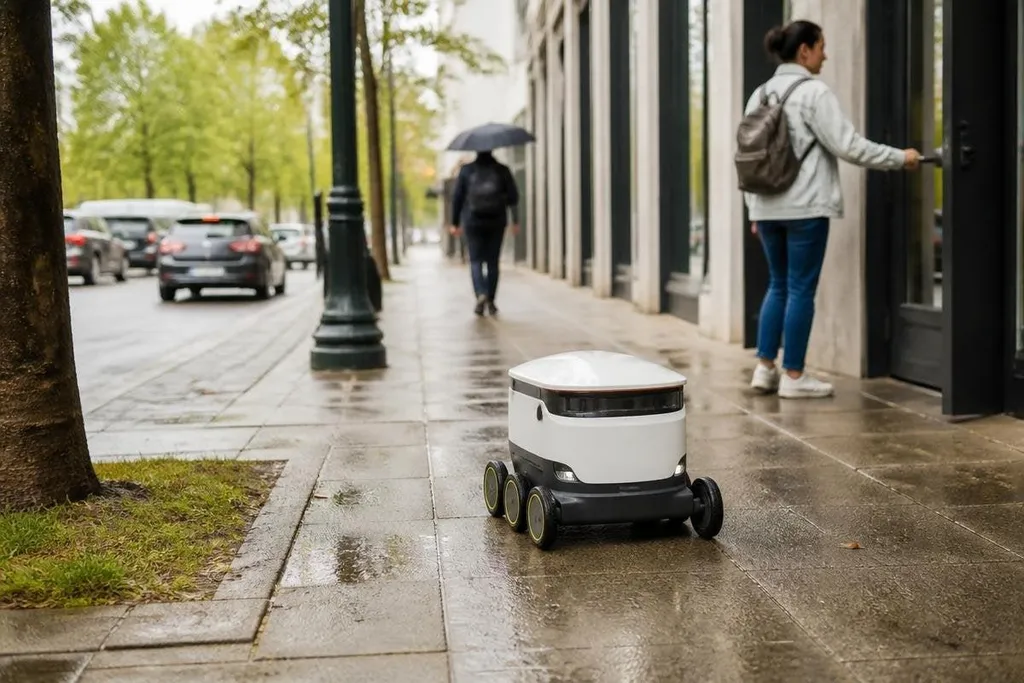
A city robot has to share space with people, cars, doors, rain, curbs, and broken pavement. That makes urban robotics harder than a controlled factory floor, so the projects worth watching are the ones built around repeatable public tasks.
- Delivery robots must stop safely when a person or vehicle blocks the path.
- Inspection robots can reduce risky work around roads, pipes, and buildings.
- City buyers will need proof of uptime, repair time, and total cost.
Delivery on public paths
Small delivery robots are a clear test of urban automation. They need cameras, LiDAR, and software that can map a route, spot an obstacle, and choose a safe stop without blocking a sidewalk.
The hard part is the handoff. A robot may reach the correct address and still fail if the customer cannot open its compartment, the curb has no ramp, or a person leaves a bag in front of it. A useful system needs a plan for those ordinary problems, not only a clean route in a demo.
A permit can decide whether a delivery robot reaches the curb at all, even when its route and sensors work. City officials and operators need the speed limit, parking rule, test site, date, and human-control plan in the same record. Reports on urban robotics from Robot24.com can put those details beside a public trial before the article turns to robots that inspect and repair.
Robots that inspect and repair
Urban infrastructure gives robots work that is dull, costly, or unsafe for people. Ground robots can inspect tunnels and drainage routes. Small tracked systems can carry cameras into narrow spaces. Aerial robots can check roofs, bridges, and power equipment when a person would need special access gear.
The useful measure is the report that follows the inspection. Can the system mark a crack, blocked pipe, or damaged cable in a form a city team can act on? A camera feed alone leaves the worker with the same search problem, only from a different screen.
Repair is harder than inspection because the robot must place force in the right spot. A gripper may need to turn a valve, hold a tool, or work around water and dust. The machine also needs a safe way to stop when the part does not move as expected.
Cleaner streets and public spaces
Waste collection, street cleaning, and grass cutting offer clear routes and repeated tasks. That makes them suitable places to test autonomous systems, provided the robot can handle parked vehicles, temporary barriers, loose rubbish, and people moving through its path.
Noise, battery charging, and service work matter here. A robot that runs for a short period but needs frequent staff visits may shift work rather than reduce it. The city still pays for transport, charging space, cleaning, software support, and a person who can take control when the route fails.
This is where public records and operating data matter more than polished footage. Buyers should ask how many hours the robot ran, how often a person intervened, and how long repairs took.
Emergency work and mobility
Urban robots may also support fire crews, police teams, medical staff, or people with limited mobility. These uses carry higher safety demands because a delay or bad sensor reading can affect a person directly.
A machine for this work needs a clear handoff to a trained operator. It should show its location, battery state, sensor limits, and reason for stopping. A remote operator may help, but that person cannot watch every robot closely if a service grows beyond a small trial.
I’d watch the systems that make their limits easy to see, because city work rewards predictable behavior more than a clever demo.
A buying checklist for city teams
Use these questions before a pilot moves onto a public route:
- Route limits: Which slopes, curb heights, weather conditions, and surface types has the robot handled?
- Human control: How does an operator take over, and how many robots can one person supervise?
- Service work: Who changes batteries, clears blocked paths, and repairs damaged sensors?
- Public safety: What happens when a child, cyclist, vehicle, or animal enters the robot’s path?
- Useful output: Does the robot create a record that staff can use, or only a live video?
- Cost record: What does one operating hour cost after staff, charging, repairs, and insurance?
The strongest urban projects will publish those answers instead of stopping at a successful route. City robotics still has to prove that it can work through bad weather, blocked paths, human mistakes, and the long service periods that make public equipment expensive.
The next useful milestone is not a larger demo fleet. It is a city that can report months of operation, intervention counts, repair time, and cost per completed task.